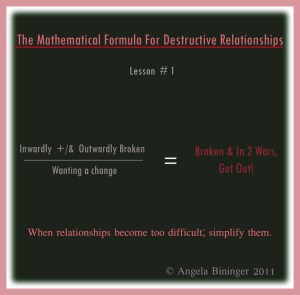
The Mathematical Formula For Destructive Relationships

All relationships have the potential to be hazardous, abusive,  and destructive. The destruction begins gradually and at times it will not end until  long after the relationship itself has ended. It just depends on how long we allow the destruction to occur before stepping up to the board and balancing out the equation.

Just as in mathematical equations that become difficult; we should simplify difficult relationships in our lives too. Simplifying can mean counseling, creating a positive change in the relationship, eliminating irritants, or in some cases simply leaving the relationship and moving forward.

Destructive relationships can be hard to spot initially. Over time the signs become more obvious, especially as we begin to see what was once a bright flower wither and fade away. Once we see the first sign of a destructive relationship, the others signs and symptoms arrive shortly after. Or so it seems.

Signs of a Destructive Relationship:

Non-trustworthy partners seem to be a dime a dozen these days. The breaking of trust is the beginning of a destructive relationship. Once trust is broken; it is time to break out the hard hats. The wrecking crew has arrived.

If two people can not trust one another the relationship officially becomes classified as a destructive relationship. The person that can’t trust suffers, and as a result the person that can’t be trusted does too. This is not healthy for either party.

Recovery from broken trust is possible if correction occurs, and it is sincere and genuine. This typically means that there will not be repeat offenses. If there are repeat offenses there may be a bigger problem. There could be a compulsive liar in the picture. If so, there are ways to break the liar down. Once you break them down and all truth becomes visible, options can be weighed out and recovery is absolutely possible. Until then, brace yourself for the other phases of a destructive relationship.

Internal Damage leaves us holding on to things that leave us felling lost, hopeless, sad, or broken. These feelings can be overwhelming and cause panic attacks, anxiety attacks, depressions, and sometimes paranoia. Internal damage can make true forgiveness seem impossible.

External Damage is when one will begin to notice things around them breaking. Whether on purpose or by accident; everything begins to break down internally and externally. This typically happens after a few incidents have occurred that created internal damage or conflict.

Withdrawn from normal activities is a symptom of a destructive relationship.  One may withdraw from friends, family,  and activities. They will isolate themselves with their partner and display signs of social avoidance. This needs attention particularly if the withdrawing from others is not for legitimate reasons. Sometimes, people grow up and apart. It doesn’t necessarily mean one is withdrawn.


Excessive Weight gain or loss is another sign that someone is in a destructive relationship. Sometimes people who are suffering emotionally will eat or starve their way to feeling in control of something. Food becomes a replacement for those gaining weight. For those in a destructive relationship that are losing weight, I have found that they starve themselves strictly to feel in control of something in their life since other areas are lacking self-control.

Control is a common characteristic seen in one or both parties involved in destructive relationships. Controlling people have the same patterns across the board, and they will often come off as very well liked socially. If they tell you where to go, what to do, who to talk to, what to wear, or how to act; they may just have control issues. If both parties are insecure and have controls issue, there could be a few Doomsday’s ahead.

Psychological Abuse occurs when one belittles another’s achievements or lack there of. Psychological abuse can be any type of mind game; from name calling to threats of suicide. One may also manipulate their partner into forgiving or at least trying to. Someone who is psychologically abusing their partner may also threaten suicide when their partner decides to leave them. If the person being abused speaks of suicide, their words ought not be taken lightly. 

Psychological abuse can be any of the following phrases (to name a few):

I said NO! You can’t wear that! Nobody cares what you think! Nobody cares about you! You don’t matter! Who are you talking to? Who’s calling here? You can’t talk to “them” ! This is MY house! I pay the bills! You are LAZY! You are worthless! Get out! I don’t need you! I never loved you! You are ugly! You are fat! I hate you!

These words can be devastating, and often lead to violence. If you are in a violent relationship leave immediately. There are shelters across the country that house men, women, and children in violent situations who are looking for relief.

Violence is not healthy in any relationship. Violence can be hitting, throwing, smacking, cornering, or intimidating another person. Violence often follows psychological abuse.

Depression is usually the last phase before one begins to receive a reality check as to where their relationship has been; where it is, and the direction it is heading. Depression can be life threatening and one suffering from depression should seek help from a certified medical professional. There are some self-help techniques for depression, and ways to fight depression. However, talking to a counselor is always a good idea. It is nice to have an outsider help us reduce difficult equations.

When things become broken inwardly and outwardly in any relationship; getting out is the only way to avoid having only bits and pieces yourself left. Repairs are much easier when something is only partially broke, than when no longer running at all.

 © Angela Bininger and The Empowerers, 2009-2011. Unauthorized use and/or duplication of this material without express and written permission from this websites author and/or owner is strictly prohibited.


Denial

Denial enables people to stay where they are. It stunts one’s growth mentally, spiritually, and emotionally.  It destroys hearts and lives.

Denial exists due to someone’s fear of facing themselves. It is from one’s a lack of insight. Denial can be paralyzing.

I have found through my own studies, that denial accompanies one’s issues of control. Denial stems from a lack of control. By denying, there is no need to address issues. Because when in denial, no issues exist except for those the one in denial  is willing to address. Denial leads to self destruction.

As I have stated in previous articles, the truth will always reveal itself. It may not be at a time we expect or even desire, but nonetheless the truth will be revealed. When the truth is revealed, it allows the one whom is in denial to lose all control and begin to face themselves. Until the denial is exposed, there is no hope. Once denial is exposed, the person must choose to snap out of it or keep suffering from the consequences of their denial.

When one accepts that they are in denial; they can truly begin to heal themselves. That ominous cloud will be lifted and lives can be restored. Only then can one begin to live a life of balance. Only then can one begin to live a life consisting of peace, and harmony. Only then will they find that their life will no longer be dictated by their fear of the truth, or exposure.

“When denial ends, life begins.”


© Angela Bininger and The Empowerers, 2009-2018. Unauthorized use and/or duplication of this material without express and written permission from this websites author and/or owner is strictly prohibited. Excerpts and links may be used, provided that full and clear credit is given to Angela Bininger and The Empowerers with appropriate and specific direction to the original content.

Signs & Symptoms of Communication Breakdown

Communication is essential for all relationships to function properly.

When communication breakdown begins, the relationship begins to suffer and the fate of the relationship enters an unknown zone. The outcome is often determined by the people involved, as well as their ability to communicate effectively until all the issues at hand are resolved.

There are many signs to communication breakdown that may need an intervention. If you find yourself struggling in a relationship facing these issues, find help.

Whether you stay or go is up to you, however, if communication doesn’t improve someone will likely be going over time.

Types of Communication Breakdown:

Stonewalling- This is when a partner is non responsive when conflict arrives. They refuse to interact at all. Stonewalling is a person’s way to protect themselves and their environment. It gives them a sense of control. Unfortunately, it gets the relationship nowhere near resolution, and often brings even more frustration to the one whom is willing to talk and communicate.

Root: The biggest reason for stonewalling in communication breakdown is guilt.

Body language: Arms are crossed and he/she refuses to make eye contact. Or, he/she walks away and refuses to communicate further. Responses are short, and usually consist of “I don’t know”.

Defensiveness This is when the person takes away from the issue at hand, and turns it around. This person often tries to find fault in someone else, rather than taking responsibility for his or her own actions. Defensiveness will even cause the one seeking the help to look for how it would help their partner, rather than themselves.

Root: Defensiveness stems from fear. Fear of truth, and fear of disappointment.

Body Language: This is usually when one begins to make erratic faces and waves his or her hands or arms in the air. The emotions of this person can be quite unpredictable at times.

Denial Denial can take us to places we never thought we would be. When one is in denial they can not hear what others try to tell them, nor can they see it. Denial is a combination of stonewalling and defensiveness. In both cases, one refuses to admit the issues. Without admittance there is no acceptance. And without acceptance, there is no change.

Root: Insecurities, low self-esteem, and fear of rejection fuels denial.

Body Language: The most common expression from one in denial is usually the person ignoring the issues. The moving hands or arms flaring, along with the statements such as “whatever” or “OK” are also pretty common. When in denial, everything going on in that person’s life is the fault of everyone else.

Secretiveness Secretive people are usually very quiet. They are often the best listeners, but offer the least amount of information about their personal lives in terms of general conversation. Secret keepers are often image conscience, and prefer everyone to think that life is perfect. They too, are in denial and fear facing reality.

The key factor in discovering a secretive person is this: If they do not ask you many questions, it is usually because they do not want questions asked. They usually seem to be intrigued by what others have to say when in conversation, and are notorious for gossiping.

Root: Poor self-image and fear of abandonment promotes secretiveness.

Body Language: Calm and relaxed. The secretive person appears to have it all together. They want the world to believe that they have everything under control.

If you are in a romantic relationship where these behaviors occur seek help. Statistics have proven that once a relationship loses the ability to maintain effective communication, it becomes toxic and/or abusive.

If we can’t communicate properly, emotions will run high and things will escalate. This is a fact. We may not be able to help your partner or change them, but we can help ourselves and change our situation.

© Angela Bininger and The Empowerer, 2009-2015. Unauthorized use and/or duplication of this material without express and written permission from this websites author and/or owner is strictly prohibited. Excerpts and links may be used, provided that full and clear credit is given to Angela Bininger and The Empowerer with appropriate and specific direction to the original content.

Spoiled Children & The Parents Who Steal Their Drive

If we give our children everything that they want, what else is there for them to work for? By giving them everything they want or think they need, we begin building a strong foundation for co-dependency. And this co-dependency may follow them for their entire life.

When I look around at different parent child relationships throughout the course of my life I see many things. In families where the child has been given everything, adulthood is difficult for them. With every snag in the line these adult children are calling their parents for help. These once spoiled young children, are now co-dependent adults that have a very hard time standing on their own feet.

When I look at people who had what would be considered a less pampered childhood, there is more success. These people who have fought their way to the top, have done it because up was the only way left to go. They had nothing. They had no one. They realized they could only count on themselves. By not having much, they were given more drive.

There is a remarkable difference when comparing the lives of children who were given it all, and children who had to fight for what they wanted. As adults it is the difference of what most consider to be success or failure, or better yet “sinking, or swimming.”

As we continue to raise our children, let us remember that they do not need everything everyone else has. Nor do children need everything they want. Why have a life full of costly activities when they would be just as content coloring a picture, playing a board game, or making a craft and spending quality time together? They also don’t need the latest sneakers or clothing, because in 6 months it will not fit them anyway.

When we spoil our children we are stealing their drive. We are teaching them that they do not have to work so hard, and that we will “get it” for them. Do we really want them still coming at 40 asking for help with car payments, mortgages, etc.? Or do we want to raise them to be independent and successful?


Children learn what they live. Question is, what exactly are we teaching this next generation? Children are as simple or as high maintenance as we teach them to be.


Families Of Alcoholics And Their Contribution To The Disease

The definition of alcoholism can vary from person to person. It is defined by Miriam Webster as continued excessive or compulsive use of alcoholic drinks. Or, a chronic disorder marked by excessive and usually compulsive drinking of alcohol leading to psychological and physical dependence or addiction.

(For me personally an alcoholic is anyone that depends on it. It is someone who needs it to get through a day, or week. It is someone who binge drinks. None the less, it is anyone dependent on it  or its effects.)

It is important for family, friends, and loved ones of an alcoholic to realize that they can not fix, cure, or control the disease. The alcoholic must decide for themselves to quit, bottom line.

You can however find support by attending Al-Anon meetings in your area.  Al-Anon is a 12-Step program modeled on the well-known program for alcoholics, Alcoholics Anonymous. It provides wonderful support for families of alcoholics. These support groups offer a lot, and will help keep you sane while battling such a nasty disease.

If there are addiction signs such as regular consumption or binge drinking, it is important to know what role you play in disease progression. Alcoholics tend to surround themselves with like-minded people or people who will enable them. By enabling them we allow the disease to progress further.

Friends, family, and loved ones of an alcoholic often fall in to one of the three categories below. Many do not realize that they are actually contributing to the disease.

The Rescuer

The rescuer basically “covers” for the alcoholic. This person will clean up after the alcoholic, deny the problem, and hide the issue. They may take over responsibilities for the alcoholic such as finances, and other areas. The rescuer feels that he/she is protecting the alcoholic. When in reality, covering up and covering for the alcoholic is only contributing to the problem. The rescuers are in denial, therefor they lie to themselves and lie for the alcoholic.

The Provoker

The provoker is one who will punish, chastise, and ridicule the drunken behavior. The provoker doesn’t care who hears, and will tell everyone what an awful person this alcoholic is. The provoker is angry, and the anger brews. The provoker often leaves the alcoholic over time. And takes a grudge with him/her when he/she goes.

The Martyr

The martyr is ashamed of the alcoholic and his/her behavior. The martyr speaks of their misery in dealing with the situation or withdraws completely.  The martyr tries to get the alcoholic to feel guilty for his/her behavior by using emotions and feelings as a tool. What the martyr doesn’t realize is that the only emotions and feelings that can be seen, felt, or heard by an alcoholic is their own. The martyr is often at risk for depression.

It is very important to seek help if you are battling this disease with a friend, family member, or loved one. Although we can’t control the alcoholic or the disease we can control ourselves. By seeking help we can prevent ourselves from being destroyed by the disease.

Their disease is not our fault but if we allow it to dictate our life and happiness, then that is our fault.

Leaving An Abusive Relationship: Where To Go

There are many resources available to both men and women who are trying to leave an abusive partner or relationship. Many are unaware of these resources. Don’t wait until it’s too late. Life is too short to live in negativity. There is a way to free yourself.

Every state in the United states has abuse shelters in counties throughout the state. If you are in fear of your life and hiding from an abuser there are even underground shelters. These are shelters that aren’t talked about openly. But by choosing an underground shelter your safety is pretty much guaranteed. Nobody will find you at an underground shelter.

Some shelters look like homes, and are disguised by their appearance alone. These are safe havens for victims of abuse, and these shelters will help you get on your feet. Many people hear the word shelter and they picture multiple bunks or cots as we have seen in the movies and on television. This is hardly the case. These shelters are often nice places. Although some may be lacking in amenities, not all of them do.

Each shelter has different rules, and accommodations. Do some homework to find out which shelter will meet your families needs the best. Most have a community living area and each person has their own private room and bathroom. In most shelters these rooms are locked and only the one rooming in there has a key. A shelter that offers privacy such as this, is ideal.

Once you are in the shelter your basic needs are met. The staff will provide you with numerous resources such as child care, employment, food, toiletries, etc. They will also provide you with clothing, vouchers for things in the community such as Y.M.C.A, movies, etc. These resources vary from shelter to shelter. The length of stay also varies from shelter to shelter, however I have seen many shelters that will allow the victim(s) to stay for up to 3 months.

Shelters will keep you and  your children safe, and are a definite way to stop/end abuse. They are secure, and will provide you will attorneys if necessary. Most of the workers are volunteers and understanding. They too were once a victim.

By retreating to a domestic violence shelter, you take the first step in reclaiming your life.

There is hope!  Life begins when the abuse ends.

Divorce: The Only Time We Die, Yet Live To Talk About It

Divorce is one of the only times in life a human will die, go through the stages of grief, and live to talk about it. The process is accompanied by a level of pain comparable to a death, or what one might experience with a serious illness.

There are several stages to the grieving process that can last for any amount of time. It all depends on how big the loss was. But to most, a broken marriage is a huge loss. Even more so if children are involved.

Shock & Denial is where the grieving process begins when a relationship ends. The shock is much worse if your spouse has already moved on with someone else. You may find yourself saying “This is not happening” “We were suppose to ____!” “I didn’t see this coming!” “None of this is my fault!” “Well maybe if I would have___.” You may even find yourself not taking him or her seriously about the divorce. You may be avoiding the issue in hopes that they change their mind.

Anger & Hatred  are by far the worst phases; aside from depression. We begin to get mad at ourselves, and the other person. Often times, we are mad at the world. Everyone is out to get us!

The anger phases comes and goes throughout the process. I have found that people often bounce back and forth between stages one, two, and three. At times we might think we have entered the next phase of grief, then a previous stage surfaces unexpectedly. Sometimes it can surface just by looking at the other person.

Anger can last for many years. Perhaps forever once it takes root. It truly varies from person to person. 

Bargaining is something we do to try and hold on to the relationship and it often occurs at the same time as phase one, denial. It goes hand in hand with denial. “I will do ___ if you take me back”, “I will buy you ___” “We can go on a trip” “Look, I finally got you that ____ that you wanted”. We sometimes even begin to bargain with God. “Lord if you fix this I will never ______ again!” “God if you ____ I will ____.

Depression can be a scary stage of grief. It is important to keep activities scheduled to keep from slipping into a deep depression. Surround yourself with loved ones and positive people. With depression one loses interest in normal activities, they oversleep or don’t get enough sleep, and the eating habits are comparable to the sleeping. They are either eating a lot, or very little at all. They may have suicidal thoughts, and struggle just to get out of bed. They are remembering only good things about the relationship. And they have very little interest in their life. They feel hopeless.

Acceptance  is when we begin to pick up the pieces. We can take the positive things we learned by having the relationship, and simply chalk up the loss. We see that there is hope. Yes, there is some light at the end of that dark tunnel. 

Once one reaches the stage of acceptance, they have regained more control of their new life. It gives them more control of their destiny. They realize that they can do it! It is when they begin to dream again, discover themselves, and begin to truly live.

I once read somewhere that it takes approximately 3-6 months for every year you were married to complete all 5 phases of grieving. From what I have seen, that number is fairly accurate. There is life after divorce. It just doesn’t truly begin until we have grieved the loss, learned our lesson that was intended for us to learn in that relationship, and move on. In doing that we have discovered who we are again, and may even get down the road and be thankful for that loss.

Healing, takes time. And time, heals. Most of the time it heals anyway.

© Angela Bininger and The Empowerer, 2009-2015. Unauthorized use and/or duplication of this material without express and written permission from this websites author and/or owner is strictly prohibited.  

Who Do You Love?

Love is the willing sacrificial giving of oneself for the benefit of others, without the thought of return. With that being said, how many of us truly love? We say things like “Well I did this for them, they can at least ____.” We keep score in our head of who has done what in the relationship such as who visits who, who calls who, etc. We don’t always admit that we do this, but we do.

So, I guess the question here is “Who Do You Love?” How many people have you loved to this degree? When is the last time you loved someone and expected nothing in return? Have you done a favor for someone you love, and when the time came for you to have a favor done for you nobody came through? Were you irritated? Did you expect them to do for you what you once did for them?

If everyone memorized and lived by this definition, we would all be a lot easier to love. Love isn’t easy, but certainly was never intended to be a battlefield. It was intended to be the “willing and sacrificial giving of oneself for the benefit of others, without the thought of return.” Yes, that is love. True love.

© Angela Bininger and The Empowerer, 2009-2010. Unauthorized use and/or duplication of this material without express and written permission from this websites author and/or owner is strictly prohibited. Excerpts and links may be used, provided that full and clear credit is given to Angela Bininger and The Empowerer with appropriate and specific direction to the original content.

Just Leave Tiger Woods Alone Already

This entire story breaks my heart. As if the family isn’t enduring enough pain already. This scandal has proved one thing. Tiger Woods is human. He makes mistakes just like the rest of us. So many are bashing him, when they too could have made the same mistakes. Any one of us could have. At the end of the day, we are all animals. We are all capable of this. It occurs in 70% of relationships.

Anyone in his position would have been vulnerable. Why is everyone bashing him verses the home-wreckers that seduced him? How could they not know that he was married? He is in fact, Tiger Woods. Granted, he shouldn’t have done those things. He should have had more character. But what about the ladies? What about the fact that they had no class or morals? It does indeed take two!

Obviously there are deeper issues beyond cheating. Cheating is typically a symptom of a troubled marriage. There are issues in the relationship long before it happens. And typically those issues are because of both people in the relationship. It takes two to make a relationship, and two to break it.

Perhaps everyone should picture themselves getting millions to do what they love, while always away from their family. While one is home taking care of the kids, the other is bringing home the bacon. Any relationship like that, will encounter problems and there will likely be adultery. It doesn’t matter who it is. And when relationships have issues, and peoples needs aren’t being met these kind of things happen. So lets let the family have a little privacy. Please?

Co-dependent Personalities & Raising Co-Dependent Children

Co-dependent personalities usually refer to life as black, or white. There is no in between. It is harder for them to see others view points, and they tend to create their own reality. A co-dependent person may often value other’s opinions over their own, compromising their own values and integrity to avoid rejection. They sometimes dress sloppy, or in baggy clothes, and even in tighter skimpy clothes, displaying their issues with self-image.

The problem with co-dependent relationship within a family, is that we adapt our feelings and boundaries as theirs. We do not like to see them making bad choices, in pain etc., so we try to control it. It can become something that eventually controls where they work, live, who they marry, meaning all major decisions are dominated, by us.

People with co-dependent personalities:

•Need to be needed

• Are  people pleasers

• Are controlling

• Afraid To Be Alone

• Mistrust others

• Are Perfectionists

• Avoid their feelings

• Excessive caretakers

• Hypervigilance (a heightened awareness for potential threat or danger)

• Often they attract needy dependent people

• Downplay their own feelings, to the point that they may not even know how they feel

• Have trouble making decisions

• Do not feel they’re lovable

• Put their own interests and hobbies aside to please others

• Are excessively loyal (even staying in abusive relationships)

• Do not ask others to meet their needs

Do You Have A Co-Dependent Relationship With Your Child?

As parents, we need to say “no” to doing tasks that foster immaturity and dependence in adult children; such as, doing their laundry, cleaning up after them, helping them with their bills, providing them with shelter (as adults), etc. It is important to learn to be separate individuals and teach them to take care of their own needs.

We need to teach our children how to tackle problems in relationships or in life, not take care of the problems for them. They need to grow up and be able to have healthy, mature, adult love relationships.  If we do things for our grown children beyond what is age appropriate, we lower their self-esteem and actually stop them from growing up.

When you are co-dependent you are enmeshed with family members’ emotional boundaries and you treat them as extensions of yourself. Therefore, you do not want to see them in pain, uncomfortable, making unwise choices, or unhappy. You try to be the one in control. You aim to fix them or their situations to be what you think is right, and good for them. You fail to see the long-term damage you are causing, you think you are only helping them.

Extreme co-dependency involves subtle control over your adult children’s choices of colleges, career, place of residency, religion, and choice of marriage partners. Over all, you dominate their decision-making abilities. Secretly you feel safe, secure, and loved when others need you and depend on you. It makes you feel important and gives your life meaning because you do not have your own life fully understood and integrated.

Co-dependency use to only be talked about in families where there was alcoholism, or drug addictions. Now, they are linking it to dysfunctional families in general. And lets face it, all families are dysfunctional. Some are just better at admitting it than others.

Co-dependent Personality Disorder is a dysfunctional relationship with the self characterized by living through or for another, attempts to control others, blaming others, a sense of victimization, attempts to “fix” others, and intense anxiety around intimacy. It is very common in people raised in dysfunctional families, and in the partners and children of alcoholics and addicts.  Most chemical dependency treatment centers now also offer treatment for Co-dependency. (definition extracted from http://www.mdjunction.com)                                                                                                                                                                                  


© Angela Bininger and The Empowerers, 2009-2012. Unauthorized use and/or duplication of this material without express and written permission from this websites author and/or owner is strictly prohibited.